- 01Boise's e-moto ban took effect July 1 — Greenbelt, sidewalks, bike paths all closed.
- 02Ada County posted 1,001 May sales — strongest month in nearly five years.
- 03Boise State enters the Pac-12 and immediately launches a $30M fundraising drive.
- 04The Capitol's sandstone was quarried by convicts who first built the road to reach it.
Some weeks the news is ambient. This week it has edges. The city drew a hard legal line on the Greenbelt — a path millions of us use — and the housing market printed its busiest month in nearly five years. Boise State put on a new conference banner. These are not unrelated events. They are a city deciding, in real time, what kind of place it intends to be.
The Civic & Policy piece earns the lead today because it changes something concrete for families across the Treasure Valley starting right now. The Market is the second anchor — the numbers are quieter than the headlines suggest, and that gap is exactly where the real story lives. The Bench carries the cultural weight of a decision years in the making.
Boise is a city spending money, drawing boundaries, and betting on itself — all in the same week.
The Greenbelt just got a hard legal line
The Boise City Council passed an emergency ordinance on June 30, 2026, that turned a lot of summer garage conversations into compliance problems overnight. If the two-wheeled electric vehicle sitting in your driveway produces more than 750 watts of power or can top 28 mph, the city now classifies it as a motor vehicle. That means it is off the Boise River Greenbelt. Off sidewalks. Off bike paths. To ride it legally on public roads, you need it titled, registered, and insured through the Idaho DMV — and you need a motorcycle endorsement on your license. The ordinance took effect July 1, skipping the usual waiting period because of its emergency designation.
The public pressure that produced this vote came largely from parents and pedestrians on the Greenbelt, the 25-mile corridor that runs through the heart of the city. Mayor Lauren McLean framed the timing directly: "We keep hearing from parents and concerned community members that e-motos are a safety concern and that the time to act is now, during the summer months when more riders are using them." Council Member Jimmy Hallyburton went further, pointing at the marketing: "These unregulated e-motos are marketed toward kids and teens despite being more powerful than many mopeds and small motorcycles that require licensing, registration, and driver's training." The near-misses and collisions on mixed-use paths, often involving unlicensed minors, had been building for two seasons.
The strongest version of the opposing argument isn't that these devices are safe — it's that the ordinance lands hardest on teenagers who rely on them to get to work, to friends, and to the river, and who now face a licensing-and-registration barrier they have no clear path through. An emergency designation means no comment period, no gradual phase-in, no grace window. A device that was legal on the Greenbelt on June 29 became a motor-vehicle compliance problem on July 1. The confusion between standard pedal-assist e-bikes and e-motos is real — and Nextdoor threads have already started lighting up with riders who aren't sure which category they're in.
The ordinance is careful to preserve Class 1, 2, and 3 pedal-assist e-bikes. If your commuter e-bike has a pedal-assist system and stays under the 28 mph threshold, nothing changed for you — the path is still yours. The line the city drew is between a bicycle and what is functionally a low-speed electric motorcycle. The city also announced a new micromobility task force charged with recommending safe spaces for these devices in the foothills and neighborhoods, which suggests the conversation about where e-motos belong is not over — just relocated off the Greenbelt.
For the families who walk and run the 25 miles of Greenbelt every summer morning, the ordinance is the city finally catching up to what the path had become. For e-moto owners, it is an immediate legal exposure they did not have last week. Both things are true, and the gap between them is where most of us are standing.
1,001 closed sales. Ada County's best month since 2021.
1,001 closed single-family sales in Ada County in May 2026. That is an 18.5% jump from a year earlier, and the strongest month for sales volume the county has posted since September 2021. The number that matters more than the total, though, is the split: homes inside the city of Boise proper sold in an average of 17 days. The county average was 33. That gap is the story. Boise proper is not just busy — it is running at a pace that leaves buyers very little room to think.
The Price Line Is Flat — Which Is the Point
The Ada County median came in at $575,900, down just 0.7% year-over-year. Pricing stayed essentially flat while volume surged. Susan Weaver, 2025 President of Boise Regional REALTORS, put it plainly: "May marked Ada County's strongest month for home sales since September 2021, with homes selling quickly across the county as inventory remained steady." Active inventory dropped 13.6% year-over-year to 1,833 available homes. The wait-for-the-crash thesis has been losing for two years; May is the data point that makes it very hard to hold.
Why the Supply Side Stays Tight
The structural answer to why inventory stays constrained is national homeowner equity, which sits at roughly $35 trillion — dwarfing total mortgage debt. Existing owners are not distressed. They do not need to sell into a falling market because there is no falling market forcing them out. Add a 30-year fixed mortgage rate hovering around 6.36% — which buyers appear to have absorbed as a new baseline — and you have a market where the ceiling on prices is buyer psychology, not seller necessity. National inflation cooled to 2.4% in the 12 months through January 2026, its lowest since early 2021, which takes some pressure off the rate picture without moving it dramatically.
Canyon County: Caldwell Passes Nampa
The Canyon County story is the affordability migration playing out in real time. The median there climbed to $444,900 — its highest in over a year. Canyon posted 522 closed sales with a median of 28.7 days on market excluding new builds. New construction accounted for roughly 39% of Canyon County homes sold in May, concentrated in Middleton and Nampa. And for the first time since last winter, Caldwell's median topped Nampa's — a signal that buyers are pushing west and north into any pocket of relative affordability they can find, and builders are meeting them there.
What a 17-Day Market Actually Means
For the buyer who has spent two years on the sideline waiting for prices to break, May's data is the uncomfortable arithmetic: volume is back, inventory is tight, and well-priced Boise homes are gone in 17 days. That is not a boom in the headline-number sense — the median is essentially flat. It is a velocity story. Same median, different market.
The Trailhead: Boise State officially joined the revamped Pac-12 on July 1, 2026. For a program that spent 20 years proving it belonged at a national table that kept moving, that date is not an administrative detail. It is the thing.
The conference that launched on July 1 includes Colorado State, Fresno State, San Diego State, Utah State, Texas State, and Gonzaga alongside heritage members Washington State and Oregon State. Boise State exits the Mountain West absorbing an $18 million departure fee; the Pac-12 absorbs a $43 million poaching penalty owed to the MW on the program's behalf. Every home regular-season Pac-12 football game will be broadcast nationally across CBS Sports, USA Sports, and CW Sports. Bronco Nation has spent years watching Blue games on networks that required a streaming subscription and a specific cable package to find. That problem is solved.
Head Coach Spencer Danielson knows exactly what the upgraded schedule means for the program's ceiling: "You've got a schedule that if you handle business, you have the report card to go play in the College Football Playoff." That sentence lands differently now. Under the 12-team CFP format, a Pac-12 champion with a clean résumé has a credible path to the bracket. The MW never offered that argument. The new conference does.
The moment the celebration turns into a bill is the 'Front Porch of Idaho Initiative,' which AD Jeramiah Dickey launched after the university's Unbridled campaign generated $220 million. The initiative seeks an additional $30 million for fiscal year 2027, pushing total campaign capital to $250 million. The local targets are specific: 23,000 football season-ticket holders for 2026, 12,000 Bronco Athletic Association members, and 400 Lyle Smith Society members. Those are real, checkable numbers. Bronco Nation is being asked, in plain language, to fund the infrastructure for the national stage it just earned.
The on-field timing helps. Boise State enters the Pac-12 with its 2026 recruiting class ranked No. 51 nationally — the highest in program history. The Albertsons Stadium North End Zone Project is under construction. The athletic department's argument is that the upgrade in facilities and conference prestige arrived at the same moment the roster finally has the national recruiting profile to match. Whether Boise's market can deliver 23,000 season-ticket holders is the question the message boards will chew on all summer. The Pac-12 banner is up. Now comes the work.
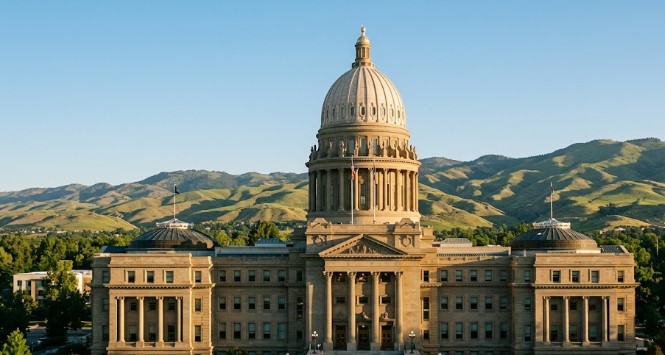
The Capitol's stone came from a quarry — and a road convicts built to reach it
You know Table Rock — the flat ridge east of town with the lit cross and the long view over the valley. You've probably been up there for a sunset. Most people think the pale scar on the south face is just weathering, the way a ridgeline wears in the desert. It isn't. That's a quarry. The honey-colored sandstone that covers the Idaho State Capitol was cut there, by hand, by convicts from the Old Idaho Penitentiary — the prison that sits right next to the trailhead you park at today.
The convict work at Table Rock started around 1905. The Capitol Commission purchased one of the Jellison Brothers' quarries on the ridge in 1906 to supply stone for the statehouse, and construction began that summer. The blocks were not small. Each one weighed roughly 10 tons. Getting them off the ridge and down to the city required a road — and the inmates built that road themselves before they could haul a single block down it. There is something that sits with you about that detail: the men who quarried the stone first had to build the road to reach their own labor.
In 1903 — before the Capitol Commission purchase, while earlier quarrying was underway — two inmates named John Stewart and William Maney were thrown about 40 feet down the ridge when a boulder they were clearing split apart without warning. Neither survived. There is no marker on the trail for them. The central rotunda and dome of the Capitol were completed in 1912, seven years after work began. The east and west wings followed in 1920. The Table Rock sandstone also went into a number of important early Boise buildings downtown — the same pale stone you see on the statehouse is in older facades across the core.
The Old Idaho Penitentiary itself operated from 1872 until 1973, when a new facility replaced it. It is now a museum — one of only four territorial-era prisons in the United States open to the public. You can walk the cell blocks and the yard on the same road that once brought work crews up toward the quarry. The sandstone they cut is still on the Capitol, still the same color it was when they hauled it down.
How to Visit
📍 Old Idaho Penitentiary Museum — 2445 Old Penitentiary Rd, Boise. The Quarry View Park shelter on Old Penitentiary Road is the trailhead for the climb toward the Table Rock quarry, adjacent to the Idaho Botanical Garden and the Old Pen.
• Adult admission: $9. Guided tours available for an additional $2. Summer hours: 10 a.m.–5 p.m. • Walk the prison yard and then turn around to look east up the ridge at the pale scar on the flank. That scar is the Capitol's skin. • For the quarry itself, the Quarry View Park trailhead puts you on the path up. Go in the late afternoon — the raking light on sandstone at the end of the day is the shot.
That's the one you tell at dinner.
- ●Eagle citywide fireworks ban — enforcement posture (violators face prosecution, not citation) — Whether any prosecutions materialize after the July 4 weekend — a local precedent (watching since 6/26)
- ●C253/SUB25-12 — State Street rezoning rehearing (8.65 acres, 9744 State St, R1A→R2) — Rehearing date posts to the city's citizen portal, opening the public-comment window (watching since 6/23)
- ●$750M recycled-water facility pause / utility affordability ($283/mo avg across five utilities) — Affordability benchmarks and funding options return to Council at summer budget hearings (watching since 6/23)
- ●BSU Pac-12 transition — Boise State enters the conference July 1, 2026 — First home Pac-12 game Sept 12 vs Memphis; North End Zone Project completion (watching since 6/23)
- ●Storyrock subdivision, South Meridian — 300+ homes on 75 acres — Binding Meridian City Council approval vote (watching since 6/26)
What did we miss this week? Reply to any issue — a real person reads every one, and the best reply runs right here next issue.